

Are you struggling to break through a weight loss plateau because joint pain or fatigue makes traditional high-impact workouts painful? If pounding the pavement or lifting heavy weights leaves you exhausted and sore, it’s time to change your relationship with gravity. Anti-gravity exercises offer a zero-impact, high-reward methodology that targets stubborn fat, balances critical stress hormones, and actively rehabilitates aching joints.
In this comprehensive guide, you will discover the science behind anti-gravity workouts—from aerial yoga to suspension training—and how you can leverage these techniques to safely transform your body. Whether your goal is to hit a 5 percent weight loss milestone or overhaul your metabolic fitness, defying gravity might just be your missing link.
What Are Anti-Gravity Exercises and Why Do They Matter for Weight Loss?
At its core, "anti-gravity exercise" refers to physical activity where your body works to stabilize and move against gravitational forces using equipment that partially unweights or suspends your body weight. While the term is often associated with specialized clinical rehabilitation (like AlterG anti-gravity treadmills), in mainstream fitness it primarily encompasses suspension training (such as TRX) and aerial yoga.
The Biomechanics of Defying Gravity
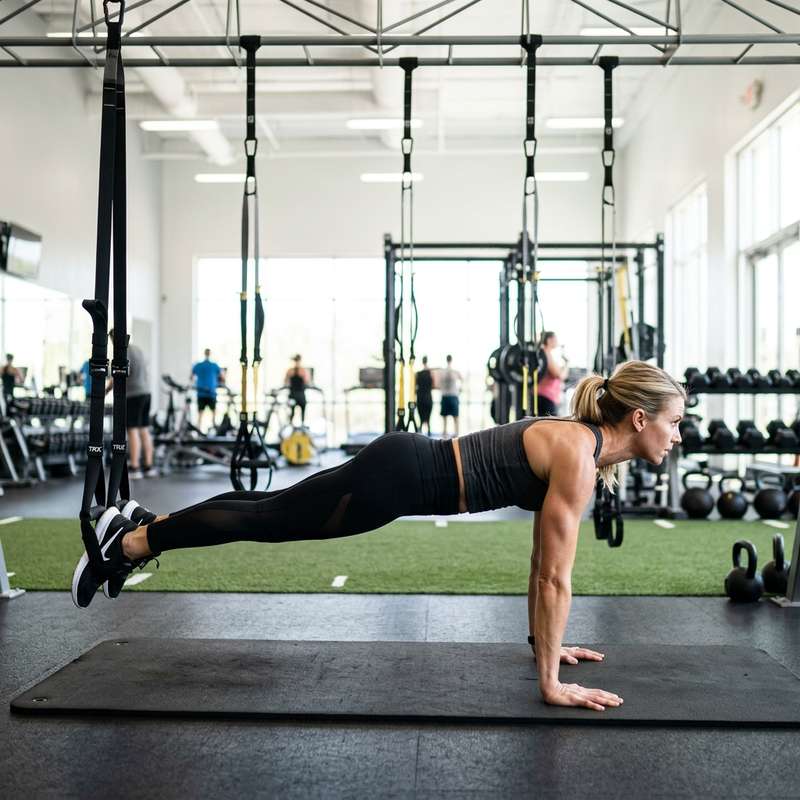
When you perform a traditional floor push-up, your joints bear the load against a fixed surface. But when you perform a suspended push-up using anti-gravity straps, the physics change entirely. Your core must continuously fire to keep your body stable and prevent swaying. This constant micro-adjustment engages fast-twitch muscle fibers and deep spinal stabilizers that stationary machines ignore.
From a fat-loss perspective, this is a game-changer. The more muscle groups you recruit simultaneously to maintain equilibrium, the higher your metabolic demand. According to clinical research published by the National Institutes of Health [NIH, 2023], workouts requiring high core stabilization can increase total caloric expenditure by up to 20% compared to seated exercises.
Bridging Recovery and High-Intensity Training
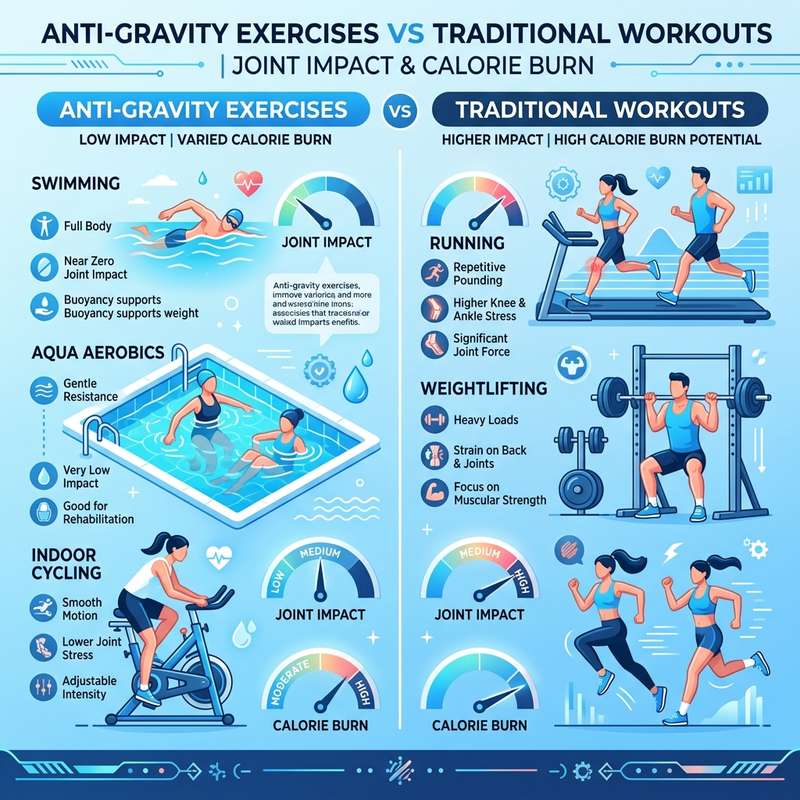
One of the biggest hurdles in weight management is avoiding joint strain and overuse injuries. High-Intensity Interval Training (HIIT) burns fat rapidly, but can be brutal on knees and lower backs. Anti-gravity exercises solve this dilemma. By supporting a portion of your weight, you perform high-intensity metabolic conditioning with virtually zero joint impact. It's a strategy we frequently recommend when structuring long-term lifestyle changes for weight loss.
The Science: Hormonal Health, Joint Recovery, and Fat Loss
Weight loss is not a simple "calories in, calories out" equation; it is heavily regulated by your endocrine system. The way you exercise dictates how your body releases cortisol, insulin, and human growth hormone (HGH).
Lowering Cortisol Through Inversion
Chronic psychological and physical stress elevates cortisol levels—a hormone known to promote visceral fat storage around the midsection. Grueling workouts can actually spike cortisol higher if recovery is inadequate. Anti-gravity training, especially aerial yoga, incorporates gentle inversion therapy (hanging upside down). Inversion triggers the parasympathetic nervous system, signaling your body to transition into a "rest and digest" state.
Lowering stress hormones creates a biological state primed for fat oxidation rather than storage. A balanced nervous system also enhances sleep quality, which is vital for sustainable weight loss and appetite regulation.
Insulin Sensitivity and Muscle Engagement
Suspension training builds dense, lean muscle tissue without adding unwanted bulk. Lean muscle mass is metabolically active, boosting your basal metabolic rate (BMR). Furthermore, engaging large muscle groups improves insulin sensitivity, allowing your cells to burn blood glucose efficiently for energy rather than storing it as adipose tissue.
According to the Mayo Clinic [2022], pairing resistance training with functional bodyweight stability work is one of the most effective ways to regulate blood sugar and accelerate weight loss.
Accelerated Joint Recovery
Carrying extra body weight increases joint compression exponentially. For every extra pound of body weight, your knees absorb four additional pounds of pressure with every step. Anti-gravity exercises relieve this burden. Hanging movements decompress the spine, hydrate intervertebral discs, and promote fluid circulation inside stiff joints without grinding bone on bone.
The Anti-Gravity Routine: A Step-by-Step Guide
Here is a foundational anti-gravity routine engineered specifically for fat loss and joint rehabilitation. Ensure all suspension straps or anchors are rated for bodyweight support before beginning.
1. The Anti-Gravity Assisted Squat
Target: Glutes, Quads, Core & Caloric Burn
How to Perform:
- Grasp suspension handles with palms facing each other, elbows tucked near your ribs.
- Step back until straps are taut.
- Hinge your hips down and back into a deep squat, allowing the straps to support your body weight while keeping your torso upright.
- Press through your heels to stand up, engaging your glutes at the top.
Why it works: The straps allow a deeper range of motion without knee strain, maximizing muscle activation in your body's largest muscle groups.
2. The Suspended Plank to Pike
Target: Deep Abs, Shoulders & Core Conditioning
How to Perform:
- Place your feet securely into the strap foot cradles and assume a strong push-up plank position.
- Lock your core to keep your hips level and avoid lower back arching.
- Keep legs straight as you lift your hips skyward, drawing your feet toward your chest to form an inverted 'V'.
- Slowly lower back down to the starting plank position with full control.
Why it works: This movement creates intense core tension, forcing every abdominal stabilizer to contract and burning high calories in short sets.

3. Aerial Inversion (Bat Pose)
Target: Spinal Decompression & Cortisol Reduction
How to Perform:
- Position an aerial yoga hammock across your lower back (sacrum).
- Gently lean backward, straddling your legs wide until you hang upside down.
- Hook your feet around the fabric to secure your hold.
- Let your head and arms hang freely toward the floor, breathing deeply for 2 to 3 minutes.
Why it works: Inversion stimulates lymphatic drainage, decompresses lumbar vertebrae, and flushes stress out of your nervous system.
4. Anti-Gravity Rows
Target: Upper Back, Biceps & Posture Correction
How to Perform:
- Hold handles and lean back with arms extended, walking feet forward until your body is at a 45-degree angle.
- Keep your body rigid in a straight line from heels to head.
- Pull your chest toward the handles, driving your elbows backward and squeezing your shoulder blades together.
- Lower back down smoothly to starting position.
Why it works: Strengthening posture muscles expands chest capacity, improving oxygen delivery during workouts and enhancing fat oxidation rates.
Real Results: A Case Study in Gravity-Defying Success
To appreciate the real-world impact of anti-gravity training, consider Maria (age 42). Maria dealt with obesity and osteoarthritis in both knees for over ten years. Traditional cardio exercises caused joint swelling, resulting in a discouraging cycle of starting and stopping her weight loss efforts.
The Protocol:
Maria followed a weekly program of 3 days of suspension training (assisted squats, rows, and core stability) paired with 1 session of restorative aerial yoga. Because her body weight was partially supported, she kept her heart rate elevated for 45 minutes straight without knee discomfort.
The Results:
Over 16 weeks, Maria lost 22 lbs while dramatically improving her mobility. Her reliance on anti-inflammatory joint medications dropped by 80%. Aerial inversion improved her sleep quality, while lean muscle gain boosted her daily resting energy expenditure.
Maria's transformation highlights that when joint pain is eliminated, consistency becomes simple. To track how your weight loss percentage progresses over time, use our free weight loss percentage calculator to measure meaningful body composition changes.
Frequently Asked Questions (FAQs)
Are anti-gravity exercises effective for weight loss?
Yes, anti-gravity exercises are highly effective for weight loss. By engaging multiple muscle groups and your core to stabilize your body against gravity, these exercises increase metabolic demand. This leads to higher caloric expenditure both during the workout and afterward due to excess post-exercise oxygen consumption (EPOC).
How often should I do anti-gravity exercises?
For optimal weight loss and joint health benefits, it is recommended to perform anti-gravity exercises 3 to 4 times a week. This allows sufficient time for muscle recovery while maintaining a high metabolic rate to support continuous fat burning.
Can beginners do anti-gravity exercises safely?
Absolutely. Anti-gravity exercises using suspension straps or aerial hammocks can be easily scaled. The straps provide assistance, allowing beginners or individuals with joint limitations to perform foundational movements with complete control.
Do anti-gravity workouts help reduce joint pain?
Yes, they excel at joint rehabilitation. Because body weight is partially suspended, impact on knees, hips, and lower back is minimized compared to running or heavy weightlifting, making them ideal for those with joint stiffness.
Is suspension training equipment safe for heavier individuals?
Commercial suspension trainers (such as TRX) are safety-tested to hold over 1,300 lbs, while professionally installed studio aerial hammocks support over 2,000 lbs. They are exceptionally durable and safe for all body sizes.
Action Plan: How to Get Started Today
- Start with Home Suspension Straps: Anchor a basic suspension trainer to a sturdy door mount. Begin with 15 minutes of assisted squats, rows, and planks 3 times a week.
- Visit a Certified Aerial Studio: Look for beginner aerial yoga or TRX fitness classes in your local area. Inform the trainer about any joint issues before class.
- Track Percentage Progress: Don't rely solely on scale weight fluctuations. Focus on how clothing fits and track your overall weight loss percentage every 2 to 4 weeks.
- Pair with Optimal Nutrition: Fuel muscle recovery with lean protein and stay hydrated to maintain intervertebral disc health. Read our best diet for weight loss guide for a balanced nutrition plan.
Conclusion
Anti-gravity exercises offer a transformative approach to fitness, particularly for anyone sidelined by joint pain, obesity, or chronic stress. By embracing suspension and gentle inversion, you unlock a low-impact, high-reward method to burn calories, protect your joints, and build metabolic momentum.
Ready to track your transformation? Use our free Weight Loss Percentage Calculator to monitor your progress every step of the way.
Sources & Scientific References
- Mayo Clinic Staff. (2022). Weight loss: Strength training vs. aerobic exercise. Mayo Foundation for Medical Education and Research.
- National Institutes of Health (NIH). (2023). Metabolic demands of unstable surface resistance training. Journal of Sports Science & Medicine.
- Harvard Health Publishing. (2021). The joint-preserving benefits of low-impact exercise. Harvard Medical School.